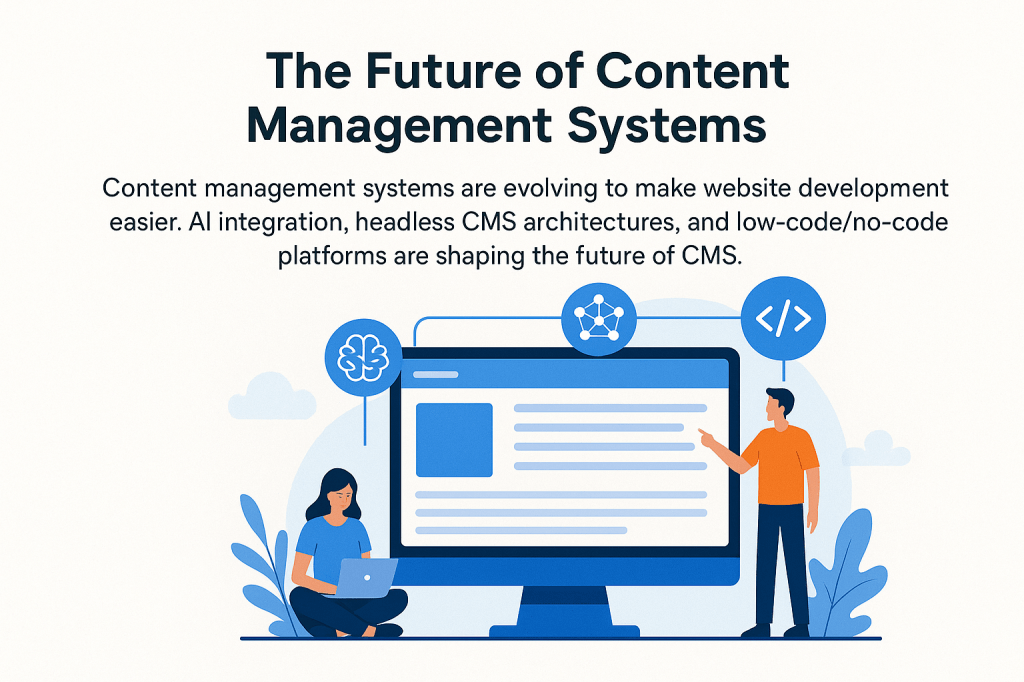
The future of content management systems (CMS) and website development is being reshaped by rapid technological advancements, user expectations, and the increasing influence of artificial intelligence. Here’s a focused look at the trends and innovations driving the next generation of CMS and web development:

1. AI-Powered Content Management
AI is transforming how websites are built, updated, and personalized:
- Automated content generation: AI tools can draft blog posts, product descriptions, and SEO tags with minimal human input.
- Personalization: CMSs are integrating AI to tailor content based on user behavior, preferences, and demographics.
- Smart asset management: AI can organize and tag images, videos, and documents for faster retrieval and reuse.
Future CMSs will act more like content strategists than mere storage systems.
2. Headless and Composable CMS Architectures
Modern developers are moving away from traditional, monolithic CMSs toward headless and composable solutions:
- Headless CMS separates content creation from presentation, allowing content to be published across multiple platforms (web, mobile, IoT, etc.).
- Composable CMS allows teams to plug in best-of-breed tools for specific functions (like search, analytics, e-commerce).
This flexibility gives developers and marketers more control over user experience, scalability, and performance.
3. No-Code and Low-Code Development
The rise of no-code and low-code platforms (like Webflow, Wix Studio, and Shopify’s Theme Editor) empowers non-developers to build and manage websites:
- Business users can launch campaigns without waiting for developers.
- Small teams can manage full-scale websites using visual editors and pre-built components.
This democratization of web development reduces cost and speeds up digital transformation.
4. Progressive Web Apps (PWAs) and Mobile-First Design
As mobile usage dominates, CMSs are evolving to support PWAs and responsive design by default:
- PWAs offer app-like performance, offline access, and push notifications.
- CMS platforms will increasingly provide tools to optimize loading speed, accessibility, and cross-device compatibility.
Expect mobile-first development to become the standard, not the exception.
5. Cloud-Native and SaaS CMS
CMSs are migrating to the cloud for better scalability, performance, and collaboration:
- SaaS-based CMSs like Contentful, Sanity, and Storyblok offer real-time collaboration and secure hosting.
- Cloud-native solutions reduce infrastructure costs and simplify deployment pipelines.
They also make it easier to integrate APIs and third-party services.
6. Cybersecurity and Privacy Built-In
With growing regulatory pressure (like GDPR and CCPA), CMSs are embedding security and privacy controls:
- Role-based access, audit trails, and encryption will be standard features.
- Consent management and cookie handling will be automated within the CMS itself.
This shift helps organizations stay compliant while protecting user data.
Conclusion
The future of CMS and website development is smart, flexible, and user-centric. Powered by AI, decoupled architectures, and low-code tools, content creation and digital experience management are becoming faster, more personalized, and accessible to all. Organizations that adopt these trends will be better equipped to engage users across platforms and scale content globally.


Leave a Reply