
Artificial Intelligence (AI) is one of the most in-demand and transformative fields today. From automating industries to powering personal assistants and healthcare diagnostics, AI is shaping the future. But how does one become an AI expert? Here’s a focused path to help you build expertise—no matter your background.

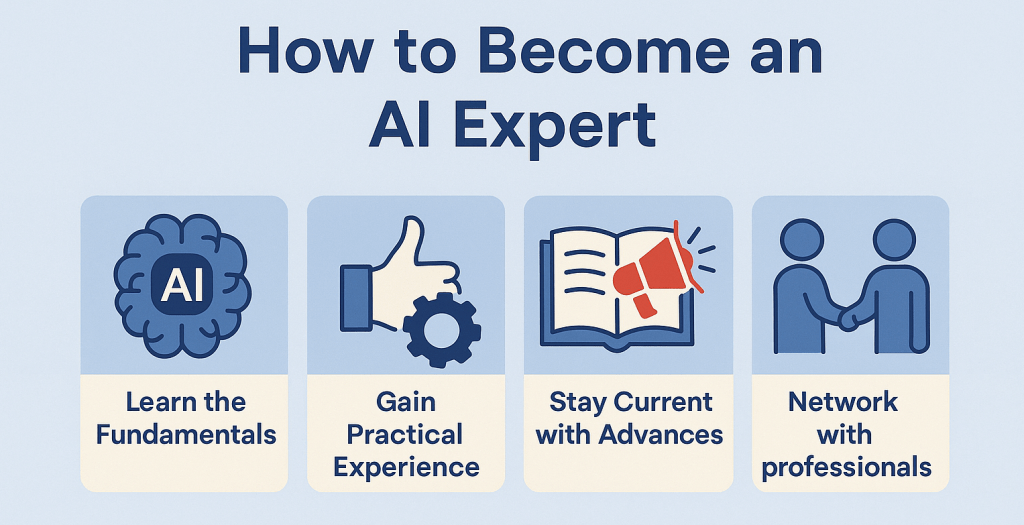
1. Start with the Basics
Begin with foundational knowledge in mathematics and programming:
- Mathematics: Focus on linear algebra, probability, statistics, and calculus.
- Programming: Learn Python, the most widely used language in AI development.
- Computer Science Fundamentals: Understand data structures, algorithms, and computational complexity.
Online courses from platforms like Coursera, edX, and Khan Academy offer beginner-friendly introductions.
2. Learn Core AI Concepts
Dive into the pillars of AI:
- Machine Learning (ML): Supervised, unsupervised, and reinforcement learning.
- Neural Networks & Deep Learning: Explore architectures like CNNs, RNNs, and transformers.
- Natural Language Processing (NLP): Understand how AI processes human language (like chatbots and translation).
- Computer Vision: Learn how AI interprets images and videos.
Resources like Andrew Ng’s ML course and fast.ai are popular starting points.
3. Get Hands-On Experience
Theory is important, but practice is essential:
- Build and train your own ML models using TensorFlow, PyTorch, or Scikit-learn.
- Use open datasets from Kaggle or UCI to experiment and solve real-world problems.
- Contribute to GitHub projects or join open-source communities.
4. Work on Real Projects
Apply your skills to practical challenges:
- Develop AI solutions for industries like healthcare, finance, or education.
- Create a portfolio with use cases (e.g., a chatbot, recommendation system, or image classifier).
- Participate in competitions (Kaggle, Zindi, etc.) to test your skills against others.
5. Stay Updated
AI evolves rapidly. Stay informed:
- Follow journals like arXiv, blogs, and YouTube channels (e.g., Two Minute Papers).
- Attend webinars, workshops, and AI conferences like NeurIPS, ICML, or CVPR.
- Read research papers and experiment with emerging models like GPT, BERT, or DALL·E.
Conclusion
Becoming an AI expert is a journey of consistent learning, experimentation, and curiosity. Whether you’re starting from scratch or transitioning from another field, the tools and resources are more accessible than ever.
👍 Like this post?
📢 Share it with your peers and aspiring AI developers.
📬 Subscribe to my blog for weekly insights on AI, ML, and the future of tech.
 The Wise Report
Leave a comment